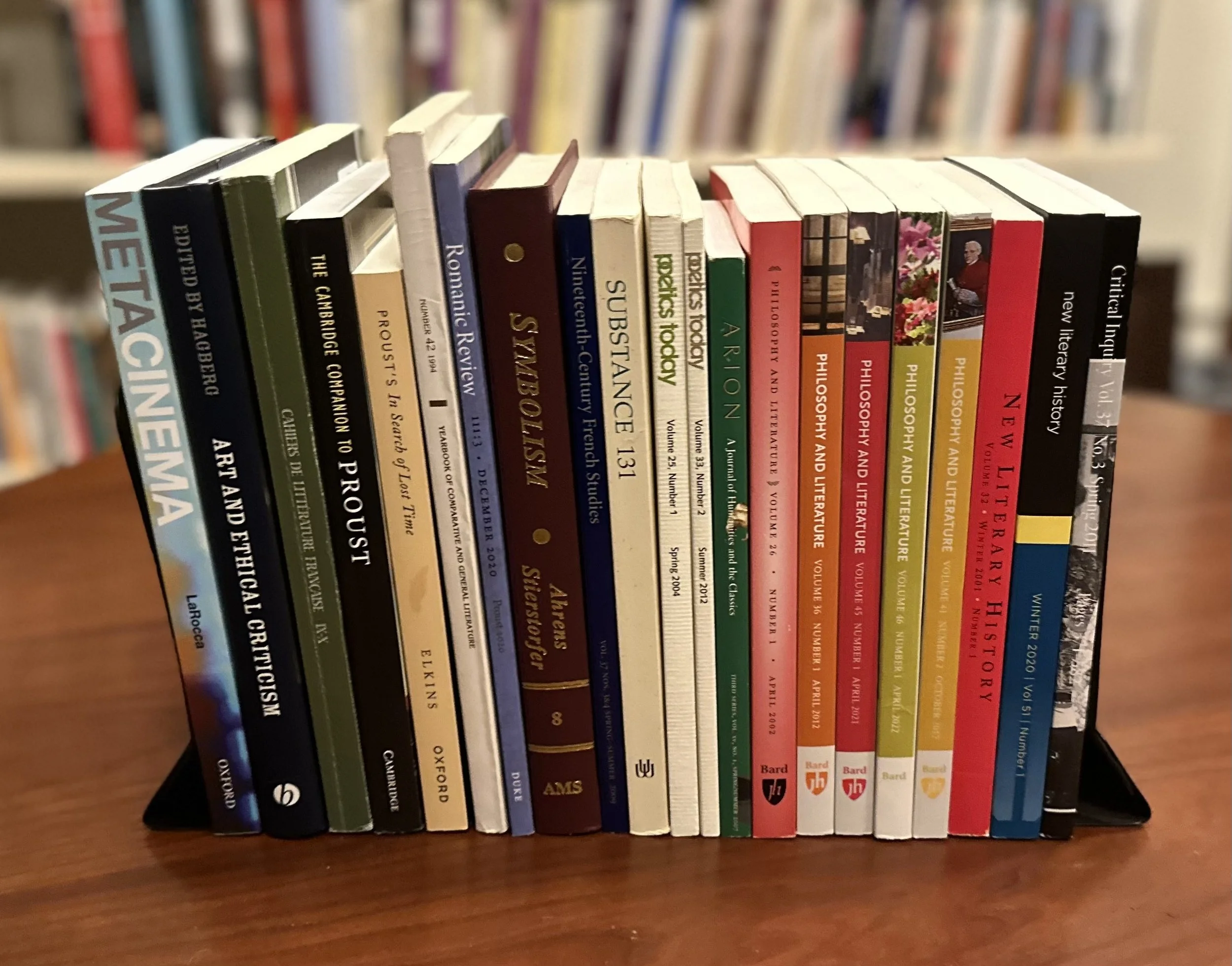
How to be changed by literature
• “Formative Fictions: Imaginative Literature and the Training of the Capacities,” Poetics Today 33:2 (2012): 167-214; abstract here.
• “In Praise of Depth: or, How I Stopped Worrying and Learned to Love the Hidden,” New Literary History 51:1 (2020): 145-76; abstract here.
• “Boiled Frog Fictions.” Forthcoming at Narrative; abstract here.
• “Passion, Counter-Passion, Catharsis: Flaubert (and Beckett) on Feeling Nothing,” The Blackwell Companion to the Philosophy of Literature, ed. Garry Hagberg & Walter Jost, Oxford: Blackwell, 2010: 218-38; abstract here.
• “Philosophical Training Grounds: Socratic Sophistry and Platonic Perfection in Symposium and Gorgias,” Arion 15:1 (2007): 63-122; abstract here.
• “Conditional Goods and Self-Fulfilling Prophecies: How Literature (as a Whole) could Matter Again,” SubStance 42:2 (2013): 48-60; abstract here.
How not to be changed by literature
• “A Nation of Madame Bovarys: On the Possibility and Desirability of Moral Improvement through Fiction,” Art and Ethical Criticism, ed. Garry Hagberg, Oxford: Blackwell, 2008, 63-94; abstract here.
• “Corruption by Literature,” Republics of Letters: A Journal for the Study of Knowledge, Politics, and the Arts 1, no. 2 (April 3, 2010); abstract here.
• “Don’t Feed the Liars! On Fraudulent Memoirs, and Why They’re Bad,” Philosophy and Literature 46:1 (2022): 137-61; abstract here.
• “Deceit, Desire, and the Literature Professor: Why Girardians Exist,” Republics of Letters 3:1 (2012); abstract here. (Featured in The Browser—an online content aggregator with over 150,000 subscribers—in February 2022.)
• “The Most Overrated Article of All Time?” Philosophy and Literature 41:2 (2017): 465-470; abstract here.
• “Art, Intention, and Everyday Psychology,” nonsite 32 (2020); abstract here.
How to become who you are
• “Still Life in a Narrative Age: Charlie Kaufman’s Adaptation,” Critical Inquiry 37:3 (2011): 497-514; abstract here.
• “Saving the Self from Stories: Resistance to Narrative in Primo Levi’s Periodic Table,” Narrative 30:1(2022): 85-103; abstract here.
• “To Thine Own Selves be True-ish: Shakespeare’s Hamlet as Formal Model,” Shakespeare’s Hamlet: Philosophical Perspectives, ed. Tzachi Zamir, New York: Oxford University Press, 2018: 154-87; abstract here.
• “Lyric Self-Fashioning: Sonnet 35 as Formal Model,” Philosophy and Literature 45:1 (2021): 224-48; abstract here.
How to dwell in metaphor
• “Dwelling in Metaphor,” forthcoming in The Cambridge Companion to Literature and Philosophy, edited by R. Lanier Anderson and Karen Zumhagen-Yekplé; abstract here.
• “Zinger, Clunker, Clanger, Flunker: On Two-Point Comparisons, and Why we Love them,” British Journal of Aesthetics 64:4 (2024): 563-84; abstract here.
How to re-enchant the world
• “The Varieties of Modern Enchantment” (with Michael Saler). Introduction to The Re-Enchantment of the World: Secular Magic in a Rational Age, ed. Joshua Landy and Michael Saler, Stanford University Press, 2009: 1-14; abstract here.
• “The Devil, the Master-Criminal, and the Re-Enchantment of the World (on The Usual Suspects),” Philosophy and Literature 36:1 (2012): 37-57; abstract here. (Selected as “Editor’s Pick” to represent the journal, May 2020.)
• “Modern Magic: Jean-Eugène Robert-Houdin and Stéphane Mallarmé,” The Re-Enchantment of the World: Secular Magic in a Rational Age, ed. Joshua Landy and Michael Saler, Stanford University Press, 2009: 102-29; abstract here. (Reprinted, in part, as “Mallarméan Magic: Retrospective Necessity, Lucid Illusion, and the Re-Enchantment of the World,” Symbolism 8 (2008), 259-78; abstract here.)
Cognitive literary studies
• “Mental Calisthenics and Self-Reflexive Fiction,” The Oxford Handbook of Cognitive Approaches to Literature, ed. Lisa Zunshine, New York: Oxford University Press, 2015, 559-80; abstract here. (Reprinted, in part, as “8 ½: Self-Reflexive Fiction and Mental Training,” in Metacinema, ed. David Larocca, Oxford University Press, 2021: 139-54.)
• “Mixed Metaphors: Gender Trouble (and Cognitive Science) in Baudelaire,” Australian Journal of French Studies 62:2 (2025): 325-44; abstract here.
• “Who’s Afraid of Cognitive Literary Studies?”; abstract here. (Forthcoming at MLN.)
• “‘Yes, and’: A Response to Responses about Cognitive Literary Studies.” (Forthcoming at MLN.)
• “Cognitive Biases are a Writer’s Best Friend”; abstract here. (Under consideration at Narrative.)
• “What do we See when we Read?”; abstract here. (Under consideration at MLN.)
Philosophy and literature
• “Kafka’s Double Bind: Freedom and Predestination in The Trial.” Forthcoming at Philosophy and Literature; abstract here.
• “The Abyss of Freedom: Love and Legitimacy in Constant’s Adolphe,” Nineteenth Century French Studies 37:3-4 (2009): 193-213; abstract here.
• “Music, Letters, Truth and Lies: ‘L’Après-Midi d’un Faune’ as an ars poetica,” Yearbook of Comparative and General Literature 42 (1994): 57-69; abstract here.
• “Introduction,” Thematics: New Approaches (with Claude Bremond and Thomas Pavel), Albany: State University of New York Press, 1995: 1-6.
Proust
• “Proust, his Narrator, and the Importance of the Distinction,” Poetics Today 25:1 (2004): 91-135; abstract here.
• “Nietzsche, Proust, and Will-to-Ignorance,” Philosophy and Literature 26:1 (2002): 1-23; abstract here.
• “Les moi en moi: The Proustian Self in Philosophical Perspective,” New Literary History 32:1 (2001): 91-132; abstract here.
• “Why a Novel?”, in Proust’s “In Search of Lost Time”: Philosophical Perspectives, ed. Katherine Elkins, New York: Oxford University Press, 2022: 19-46; abstract here.
• “The Texture of Proust’s Novel,” The Cambridge Companion to Proust, Cambridge: Cambridge UP, 2001: 117-34; abstract here.
• “Why Proust Isn’t an ‘Essayist,’ and Why it Matters,” Romanic Review 111:3 (2020): 392–407; abstract here.
• “‘Un égoïsme utilisable pour autrui’: le statut normatif de l’auto-description chez Proust,” Morales de Proust, ed. Mariolina Bertini & Antoine Compagnon, Paris: L’Harmattan, 2010: 83-99; abstract here.
Journalism
• “The Best Marcel Proust Books,” interview at Five Books, May 6, 2025. This interview was recommended by The Browser (May 10, 2025).
• “Five Best: Books on Memory,” The Wall Street Journal, November 11, 2022.
Responses and occasional pieces
• “Why Read Proust in 2023?” Oxford University Press blog, March 27, 2023.
• “The World According to Proust: Five Big Ideas,” Next Big Idea Club, January 2023.
• “Sobre uma recensão estranha na Forma de Vida,” Forma de Vida 3 (2013), online.
• “Μια ωραία ζωή” [“A Beautiful Life”], trans. Chrysoula Mentzalira. TheAthens Review of Books, July-August 2011, 14-18.
• “Il falso di sacre teorie,” an interview with Remo Ceserani. Il Manifesto, May 22, 2011: 10-11.
• “Secular Magic in a Rational Age.” The Human Experience, February 2010.
• “Re-Enchantment” (with Michael Saler), The American Scholar, Summer 2009: 10-11.
• “A Beatrice for Proust?” Poetics Today 28:4 (2008): 607-18.
• “Treason of the Readers: Karl Heinz Bohrer and the Autonomy of the Aesthetic,” Stanford Presidential Lectures Forum, October 1998.
Reviews
• “The Point of the Pyramid: Michael Fried’s Flaubert's ‘Gueuloir,’” Los Angeles Review of Books, July 20th, 2013.
• “Proust Among the Psychologists”: Review of Edward Bizub, Proust et le moi divisé: La Recherche, creuset de la psychologie expérimentale (1874-1914), Philosophy and Literature 35:2 (2011): 375-387.
• “Philosophy to the Rescue”: Review of Mark William Roche, Why Literature Matters in the Twenty-First Century, and Frank B. Farrell, Why Does Literature Matter?, Philosophy and Literature 31:2 (2007): 405-19.
• “The Paradox of Perfection”: Review of Thomas G. Pavel, La pensée du roman, Poetics Today 26:1 (2005): 161-68.
• “Accidental Kinsmen: Proust and Nietzsche”: Review of Duncan Large, Nietzsche and Proust: A Comparative Study, Philosophy and Literature 27:2 (2003): 450-55.
• “Philosophy as Self-Fashioning: Alexander Nehamas’s Art of Living,” with R. Lanier Anderson, Diacritics 31:1 (2001): 25-54.
• “Pearson on Mallarmé,” Review of Roger Pearson, Unfolding Mallarme: The Development of a Poetic Art, Nineteenth Century French Studies 26:3-4 (1998): 463-65.
Just for Fun
• “Lost Fragments of the Philosophical Investigations” (parody).